Product and workflow design · CopyHub
Designing CopyHub for enterprise UX copy workflows
CopyHub began with an operating reality: enterprise UX copy rarely lives in one place, yet every approved word must return safely to the design source.
- Written by
- Imajin Editorial Team
- Published
- Reading time
- 7 min read
In brief
What this article covers
- CopyHub was shaped with a highly experienced senior UI/UX design partner.
- The workflow reflects corporate and enterprise design-delivery realities, not a generic writing process.
- A Figma plugin keeps copy connected to the interface where it appears.
- Discussion, history, conflict control, and approved updates create a governed path back to design.
The workflow problem
Interface copy becomes difficult when ownership crosses tools and teams.
In a large organisation, interface copy may pass through product, design, UX writing, marketing, legal, compliance, localisation, and stakeholder review. The words appear in Figma, but discussion and approval often move into documents, spreadsheets, comments, messages, or meetings.
That fragmentation creates practical risk. Reviewers lose visual context. Designers reconcile changes by hand. Teams cannot easily tell which wording is current, who changed it, or whether an approved update has made its way back into every relevant design.
Domain partnership
The product was rooted in senior enterprise design experience.
Imajin developed CopyHub in partnership with a highly experienced senior-level UI/UX designer whose work includes deep exposure to corporate and enterprise design-delivery pipelines. That operating experience shaped the product from the beginning.
Instead of starting with a generic collaboration feature list, we examined how copy actually moves through complex design organisations: where reviews break down, which participants need access, how decisions are recorded, and how approved language returns to production design without creating another manual reconciliation task.
Connected to the source
A Figma plugin keeps words connected to their interface.
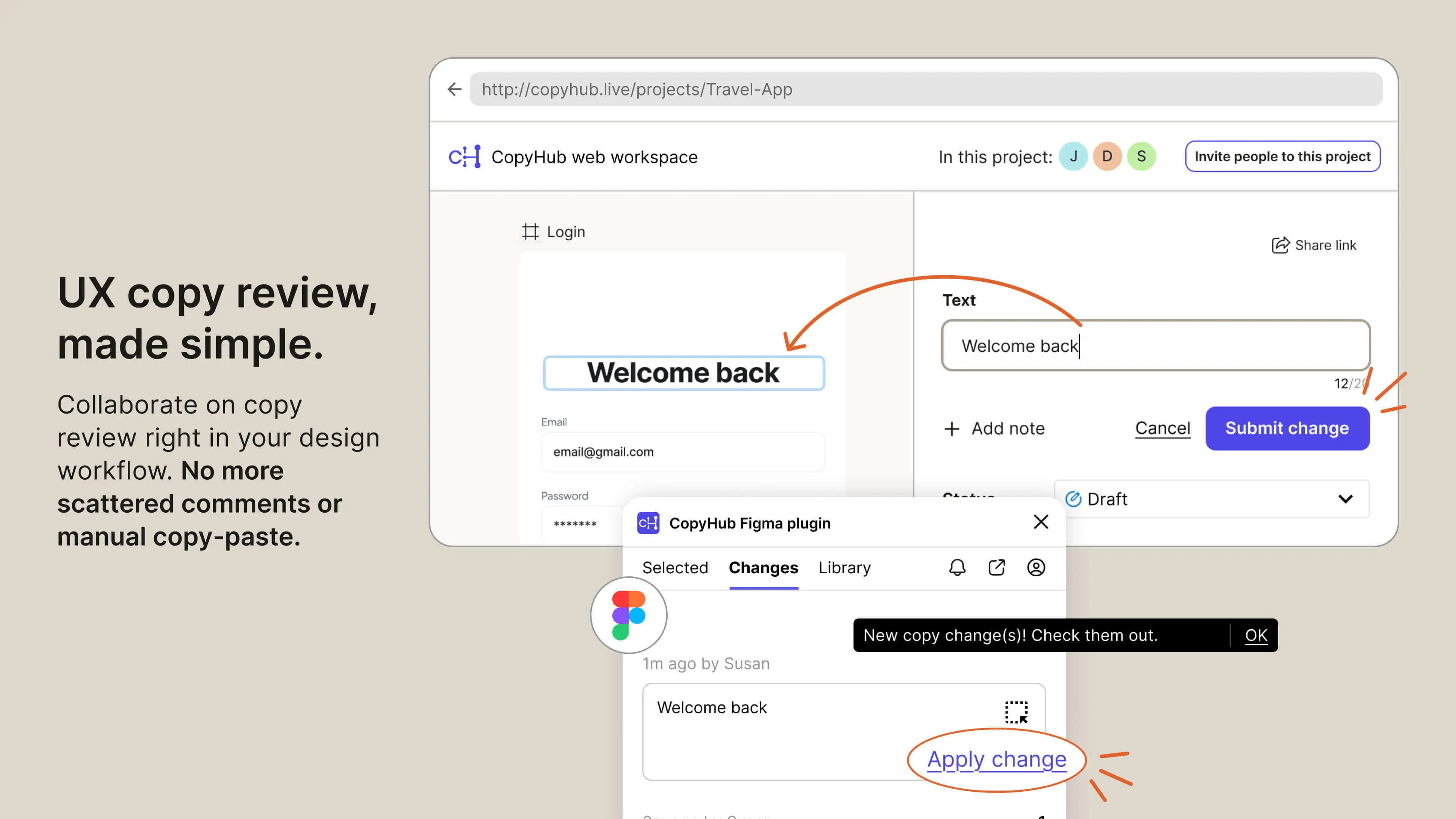
CopyHub uses a Figma plugin to extract UX copy from design files into a focused collaborative workspace. This preserves the relationship between the text and the design source while giving copy owners and reviewers a purpose-built environment for language work.
The plugin is not an accessory to a separate document workflow. It is the bridge that lets teams move copy out for structured review and apply approved changes back to Figma. That closed loop reduces copying, ambiguity, and avoidable rework.
Controlled collaboration
Review needs context, history, and a safe way to resolve change.
The workspace brings live editing, discussion, version history, editor-based access, and conflict controls into one workflow. Participants can focus on copy without requiring every stakeholder to manipulate the design file directly.
History makes decisions traceable. Discussion stays beside the relevant content. Conflict handling recognises that designs and copy can evolve at the same time. Together, these capabilities support governance without turning every wording change into a heavyweight process.
- 01
Extract
Bring interface text from Figma into a reviewable workspace while retaining its design relationship.
- 02
Review and discuss
Give stakeholders a focused place to evaluate language with comments and shared context.
- 03
Edit with history
Track wording changes so teams can understand what changed and recover earlier decisions.
- 04
Control conflicts
Surface competing updates rather than silently overwriting work across Figma and the workspace.
- 05
Apply approved copy
Return accepted changes to the source design through the plugin instead of manual transcription.
Product principle
Enterprise usefulness comes from fitting the delivery system.
Tools for large teams do not become enterprise-ready simply by adding permissions. They must fit existing ownership, hand-offs, review expectations, and source-of-truth decisions. CopyHub concentrates on a narrow but expensive seam in that system: managing interface language between design and approval.
That focus is deliberate. By combining product engineering with first-hand workflow expertise, Imajin built a live product that solves a specific operational problem while remaining approachable to the people who must use it every day.