
Product roadmap · CopyHub
What if AI could write in your company’s voice—not just sound like AI?
Teams do not need another blank chat box. They need help creating better product copy without losing the voice, terminology, context, and approval process their organisation already relies on. That is the direction we are exploring for CopyHub.
- Written by
- Imajin Editorial Team
- Published
- Reading time
- 7 min read
In brief
What this article covers
- Create and improve product copy using your company’s own voice, terminology, and approved examples.
- Bring forward knowledge your team has already developed in a Gemini Gem or existing style guide.
- Keep AI suggestions inside CopyHub’s familiar review, discussion, versioning, and Figma workflow.
- Access the feature within existing plans, with clear usage allowances and limits for each plan.
The next CopyHub roadmap
The hard part is not generating words. It is generating the right words for your organisation.
A designer can ask a general-purpose AI tool to write a button label or shorten an error message in seconds. But getting a plausible sentence is rarely the real challenge. The difficult part is making sure it sounds like the company, uses the right product terminology, fits the interface, follows accessibility guidance, and can be reviewed by the people accountable for the final experience.
That work becomes harder as a company grows. Product teams move quickly, writers support several squads, approved language is scattered across documents, and the same phrase can be rewritten in five different ways. People spend time searching for guidance, moving copy between tools, and explaining the same rules again in every prompt.
For existing CopyHub users, our next roadmap direction is designed to reduce that friction. We are exploring AI-assisted copywriting where your company’s writing knowledge becomes part of the CopyHub workflow—not another disconnected destination your team has to manage.
Who it can help
Built for teams that care about consistency as much as speed.
This direction will be especially useful for companies with several product squads, established brand or content standards, multiple markets, regulated language, or a growing interface that is becoming difficult to keep consistent. It can support product designers who need a stronger first draft, content designers reviewing work across teams, product managers refining a flow, and localisation teams preparing clear source copy.
It is also relevant to organisations evaluating CopyHub—or tools like it—because AI assistance is most useful when it is connected to the work around it. Copy needs design context, review, discussion, ownership, version history, and a reliable path back into Figma. Generation alone solves only the first few seconds of a much longer process.
- 01
Product and design teams
Move from placeholder text to considered interface copy without leaving the design workflow.
- 02
Content and brand teams
Make approved guidance easier to follow across more products and contributors.
- 03
Enterprise organisations
Support shared terminology, accessibility, legal requirements, and different product or market contexts.
- 04
Growing companies
Build consistent writing habits before fragmented language becomes expensive to correct.
Your style, in the workflow
A style guide should be more than a document people remember to open.
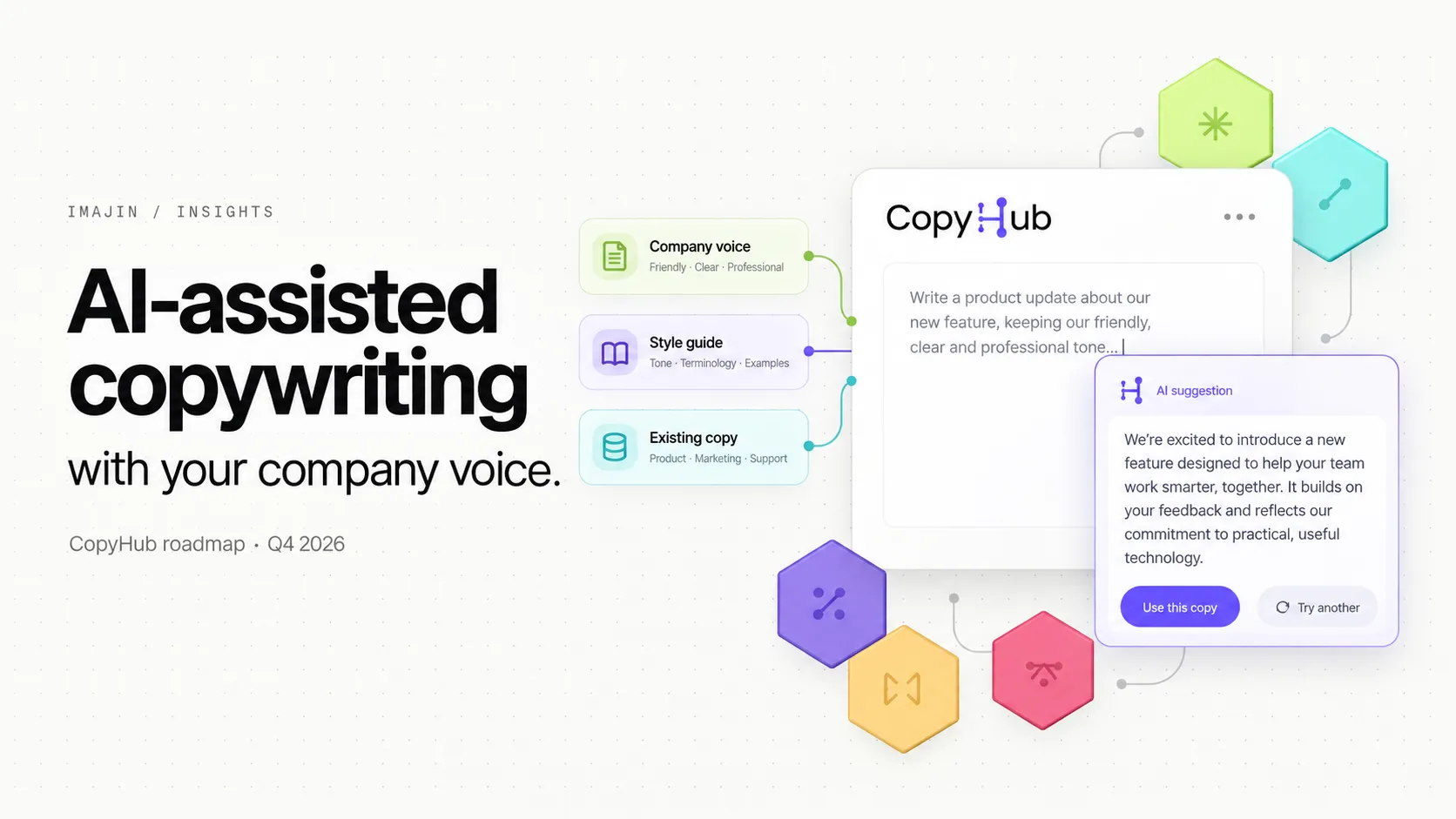
We want CopyHub workspaces to be able to use a company style profile: voice principles, preferred terms, words to avoid, spelling conventions, accessibility guidance, legal requirements, and examples of copy the team has already approved. Different profiles could support separate brands, products, audiences, or markets while keeping ownership and changes visible.
With that context available, a team could ask CopyHub to make an empty state more useful, shorten a mobile label, clarify an error, create a few alternatives, or adapt a message for a particular audience. The assistance would consider the selected Figma content and the relevant company guidance instead of responding to an isolated prompt.
The result should feel less like asking a stranger to write for your product and more like working with a colleague who has read the guidance. It will not remove the need for judgement. It should remove much of the repetitive work that comes before it.
Build on what you already have
Already created a company writing Gem in Gemini? That work should not be wasted.
Some teams have already invested time in a Gemini Gem that understands their tone of voice, terminology, writing principles, and reference material. Others have built similar knowledge in internal prompts and shared documents. We want CopyHub to provide a practical way to bring that foundation into the product rather than asking teams to start again.
Our first approach could be a guided setup: bring across the instructions used by your Gem, add the original style-guide documents and approved examples your organisation is authorised to use, and let CopyHub organise them into a reviewable style profile. Before the profile becomes active, the team can check the extracted rules, resolve conflicting guidance, and test it against representative product copy.
Today, Gemini Gem sharing does not provide a dependable one-click export of the complete Gem configuration for another product to import. We would rather be clear about that limitation than build a fragile shortcut. A guided path can still preserve the valuable thinking behind the Gem, while future official integrations could make the transfer more direct.
- 01
Bring your instructions
Reuse the voice, goals, constraints, and examples your team has already refined.
- 02
Add trusted source material
Include the original style guides and approved copy that your organisation controls.
- 03
Review before activation
See how CopyHub interpreted the guidance and correct anything that is unclear or outdated.
- 04
Test with real scenarios
Compare suggestions for buttons, errors, onboarding, empty states, and other representative product moments.
Designed around real work
AI suggestions should enter the same workflow as every other copy decision.
We are not planning an “auto-write everything” button. CopyHub should offer focused actions at useful moments: draft, shorten, clarify, adjust tone, improve accessibility, or create alternatives. Each suggestion can be compared with the original and accompanied by a concise explanation of the guidance it followed.
From there, the existing CopyHub workflow still matters. A suggestion can be edited, discussed, approved, tracked in version history, checked for conflicts, and applied back to Figma. The AI provides a starting point; your team decides what is right for the customer and the product.
Over time, approved and rejected suggestions can help a workspace understand which guidance is useful and where it needs improvement—under controls chosen by the organisation. Success should not be measured by how many words AI generates. It should be measured by whether teams reach better, approved copy with less unnecessary effort.
Quality before novelty
The experience needs to earn trust, one suggestion at a time.
Good product copy is contextual. A short label may need a strict character limit. An error message should explain what happened and what the user can do next. A financial or healthcare flow may need approved language that cannot be casually rewritten. CopyHub can use the component, surrounding content, audience, and applicable rules to shape each request.
We also want to combine language generation with practical checks for banned terms, length, placeholders, reading level, and required wording. For higher-risk copy, teams should be able to require specific reviewers or treat AI as suggestion-only. Fluent wording should never be mistaken for approved wording.
This approach also helps us balance quality and cost. CopyHub can reuse stable style context, select only the guidance relevant to a request, and reserve more capable processing for work that genuinely needs it. That means more of the included allowance can go towards useful suggestions rather than repeatedly processing the same material.
Included in existing plans
We want teams to experience the value without adding another product fee.
AI-assisted copywriting is planned as part of CopyHub’s existing plan structure. We are not proposing a separate add-on. Each plan would include an AI usage allowance and rate limit suited to that plan, with higher plans supporting greater team usage.
Usage should be easy to understand. Workspace owners should be able to see what remains before a limit is reached, and the product should avoid surprises. If a workspace uses its monthly AI allowance, the rest of CopyHub—including editing, review, discussion, history, and applying copy—should continue to work as usual.
The limits are there to keep the feature sustainable and predictable, not to make it difficult to use. As we work with design partners, we will learn which actions deliver the most value and how to set allowances that support real product workflows.
Help shape what comes next
What would make company-aware AI writing genuinely useful to your team?
We believe the next meaningful step for AI copywriting is not more generic output. It is assistance that understands the organisation, appears in the right workflow, and leaves people in control of the final decision.
If you already use CopyHub, this is an early view of what we are working towards. If your company is evaluating CopyHub or rethinking how product copy moves between design, content, product, legal, and localisation teams, we would value your perspective too.
Does your company already maintain a style guide, a Gemini Gem, or another internal writing assistant? Would faster first drafts, consistency checks, explainable suggestions, localisation support, or easier review make the biggest difference? Share your thoughts with Imajin and help us shape the next stage of CopyHub.