
Understand
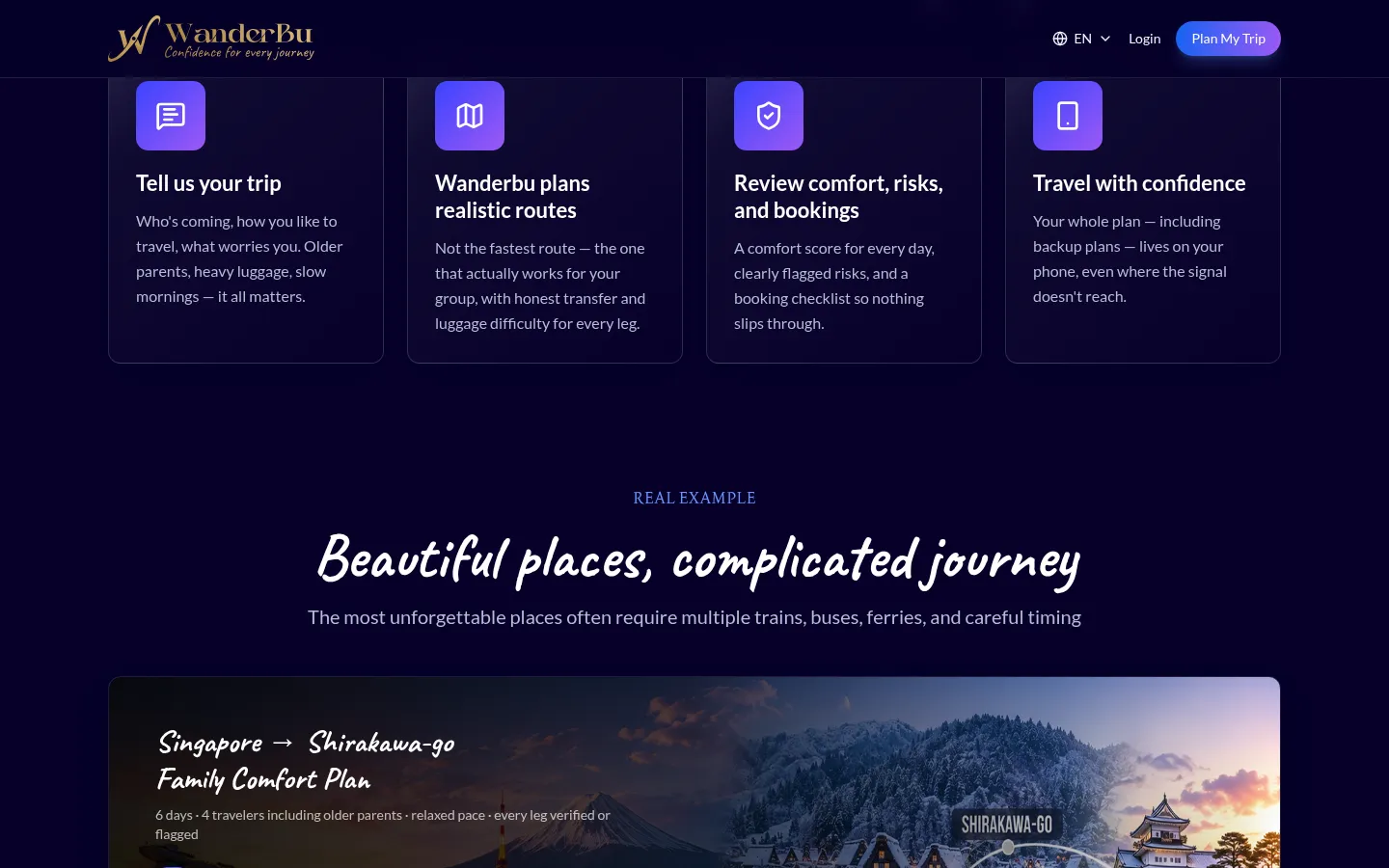
Capture who is travelling, what matters to them, their logistical constraints, and every booked commitment.
Loading project…
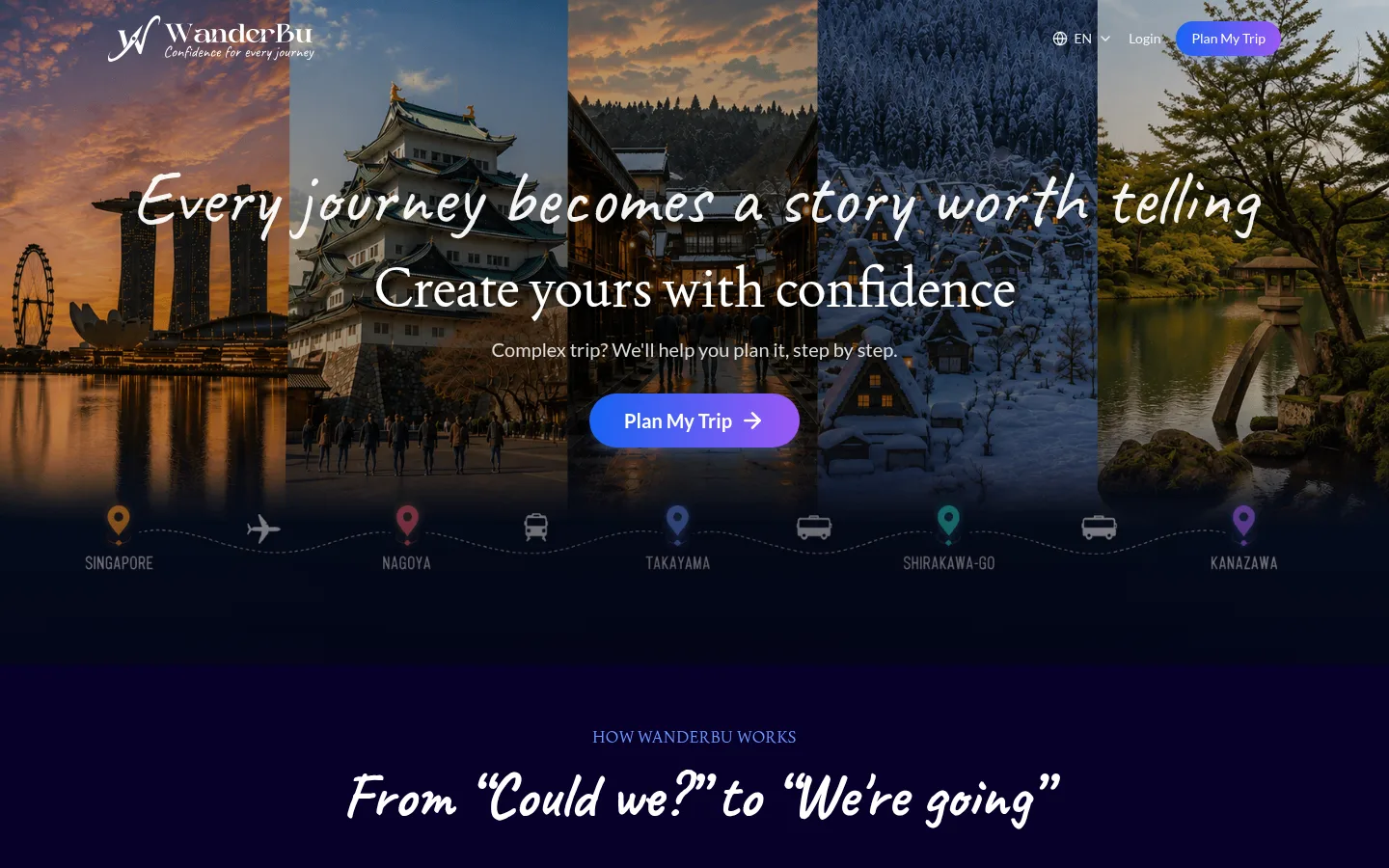
An AI travel-confidence engine born at the Gemini XPrize hackathon, turning complex regional journeys into realistic routes, comfort scores, booking checklists, and backup plans.
Executive summary

Context
WanderBu began as Imajin’s Gemini XPrize hackathon idea: help more people confidently reach harder destinations by reasoning across transfers, stays, meals, pacing, luggage, mobility needs, and route risks.
Imajin’s role
Imajin conceived, designed, and built WanderBu as an owned product, combining Gemini reasoning, Google Places API context, and additional knowledge retrieved through RAG in a staged itinerary-generation system.
What we delivered
Inside the work
The product thesis
WanderBu is a travel-confidence layer connecting what travellers want with what travel businesses and destinations must deliver — one journey, two operating views, and one continuous context.
Travel has more information than ever. Confidence is still missing.
Capture who is travelling, what matters to them, their logistical constraints, and every booked commitment.
Turn fragmented information into a structured itinerary and a journey that can genuinely be taken with confidence.
Remain relevant through preparation, collaboration, adaptation, discovery, and the travel days themselves.
Bridge traveller intent with travel businesses, local partners, creators, and destination ecosystems.
One continuous context
Traveller
WanderBu
WanderBu Intelligence
Gemini reasoning, Google Places API context, and retrieved travel knowledge move through understand, research, acquire, discover, score, organise, check, repair, and present stages.
Business
Why now
The opportunity is not another itinerary generator. It is the operating layer between intent and execution.
Travellers increasingly expect synthesis and decisions, not another page of results. Planning is moving from search boxes towards conversation and agents.
Intent becomes visible before booking. Understanding a trip early makes later recommendations, offers, and fulfilment more relevant.
Southeast Asia already has a large digital travel economy, while cross-border, multilingual, and family journeys remain operationally complex.
The Bu interaction layer
Prepare and stay safe
Turns the plan into prioritised booking checklists, reservations, practical essentials, connectivity guidance, and emergency information.
Travel with continuity
Carries shared itineraries, booked commitments, comfort analysis, route risks, and fallback options into the journey itself.
Discover in context
Surfaces useful places, local experiences, and relevant partner offers along the traveller’s actual route rather than outside the trip context.
Market context
The initial focus is Southeast Asian outbound travellers navigating complex, multilingual, family, and cross-border needs; then independent planners, agencies, and creators who need itinerary, client, and pipeline operations.
Market context, not WanderBu revenue. Source: Google, Temasek & Bain, e-Conomy SEA 2025. The 2030 figure combines projected accommodation and flight GMV. Read the e-Conomy SEA 2025 report.
Business model
A free entry point with premium credits and functions for more capable journeys.
B2B SaaS for independent planners and agencies, explored at US$88 monthly or US$888 yearly.
Affiliate, referral, and booking economics tied to relevant decisions inside the journey.
Contextual local offers and verified discovery that appear when they are genuinely useful.
Campaigns, intent insights, and enterprise or API pathways for destination ecosystems.
A future layer for trusted trip validation, community knowledge, and travel content creators.
Inside the product
A detailed account of the expertise, architecture, and product decisions behind WanderBu.
Building WanderBu taught us that a dependable travel planner needs more than a model and a pile of documents. Here’s how we choose what to research, keep evidence attached, review changes, and test search before release.
Read the product insightOutcome
Next case study
Ascenda